This is a follow up on our trip to Italy and France last summer where we got the chance to visit the cultural complex at Firminy-Vert. Here are a few quick sketches made on site; a few trying to capture the feeling of the interior space.


Architectural Research & Documentation
This is a follow up on our trip to Italy and France last summer where we got the chance to visit the cultural complex at Firminy-Vert. Here are a few quick sketches made on site; a few trying to capture the feeling of the interior space.
The Klumb house, previously known as el Rancho Cody, was acquired by Henry Klumb in 1947. The house belonged to José Ramón Latimer and his wife Esther C. Cody who rented out rooms. In 1949 Klumb remodel the structure which was a traditional pitched-roof wood structure raised from the terrain with a surrounding balcony that opened directly towards the outside.
The intervention instead of consisting of additions to the original layout was more about subtraction as if adhering to Mies’ “less is more” predicament. Klumb eliminated — almost entirely — the enclosing walls to allow continuity between the public spaces of the house and the veranda. Thus, the living room (in the front) and the dinning room (at the back) — maintaining the original layout — were left completely open. The bedrooms remained partially enclosed and large operable pivoting windows allowed for privacy while allowing cross ventilation and when opened visual and physical connection with the balcony.
Klumb, his wife Else and their two children Peter and Richard lived in the house until 1984 when Klumb and Else died as a result of a car accident.
After their death, the house was acquired by the University of Puerto Rico in 1986, but was left abandoned to its current state of deterioration. In 1997 it was included as a Regional Monument in the National Register of Historic Places and in 2012 it was elevated to the status of National Monument by the same entity. In 2014 the house was included in the World Monuments Watch and in March Comité Casa Klumb was created to aid at the restoration of the structure.
Here are a few drawings I made during a visit to the Casa Klumb organized by the committee as part of a series of activities aimed at raising awareness of the house condition and its future restoration.
 The living room
 The dining room
 The dining room table
 floor plan and axon
I forgot to paste these views in my last post.
 View towards the altar
 Canon de lumiere at the crypt

The Villa Savoye in Poissy (outside of Paris) was designed by Le Corbusier and his cousin Pierre Jeanneret. Built in reinforced concrete the house best exemplifies Le Corbusier’s five points of modern architecture. These were:
1. pilotis – a grid of reinforced concrete columns that served as main structural support, elevating the house from the ground to allow for the continuity of the landscape underneath.
2. plan libre – given the pilotis there was no need for load-bearing walls to support the structure allowing interior walls to be placed freely and only where the program required them.
3. toit jardin or roof garden – an open-air terrace that reclaimed the landscape displaced by the occupation of the building.
4. fenêtre en longueur – horizontal windows that provided rooms with an equal distribution of natural light and ventilation.
5. façade libre – unconstrained by load-bearing considerations building skins could be arranged freely to serve the requirements of the interior spaces.

 the setting
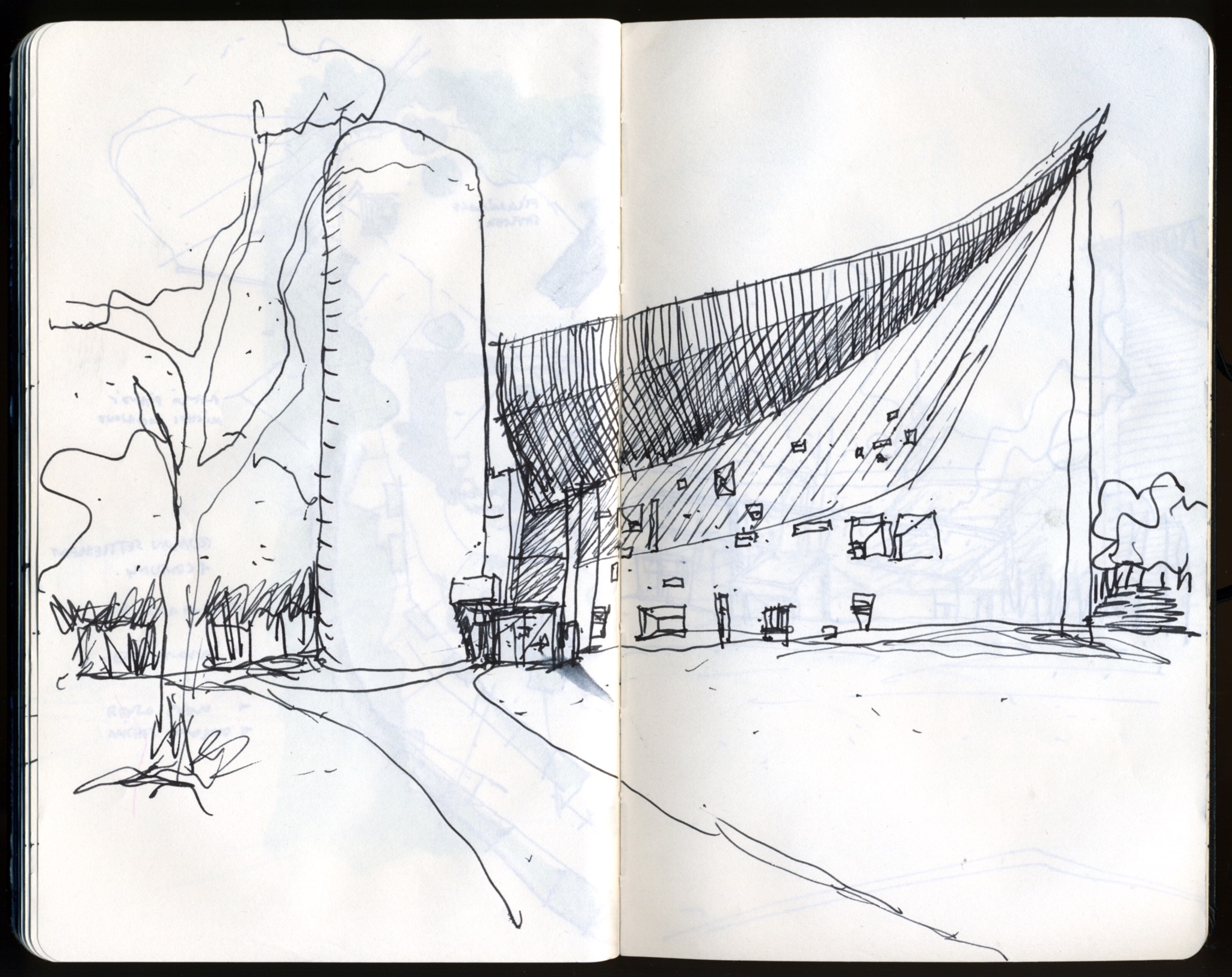 approaching the summit


 the exterior altar
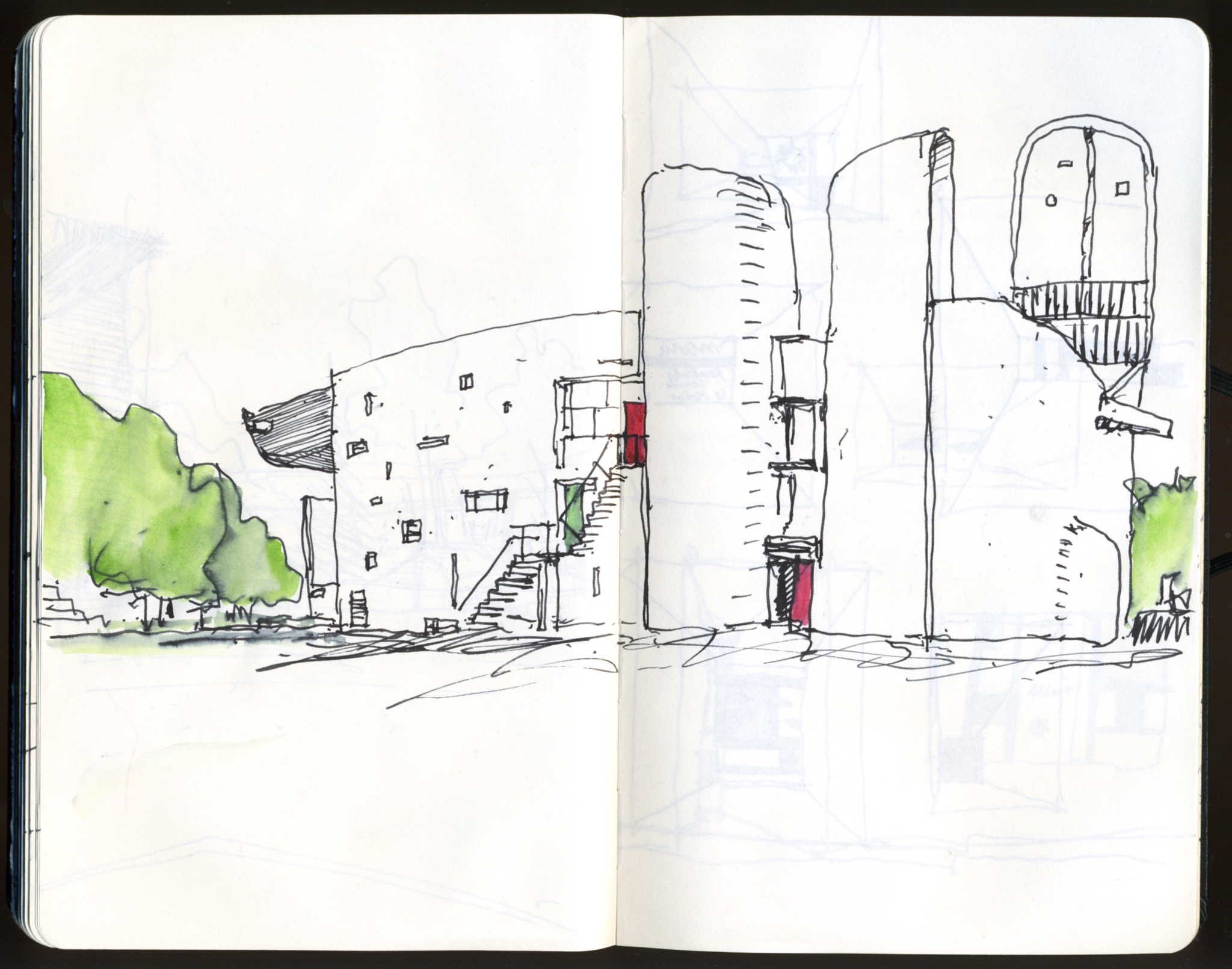 the north façade
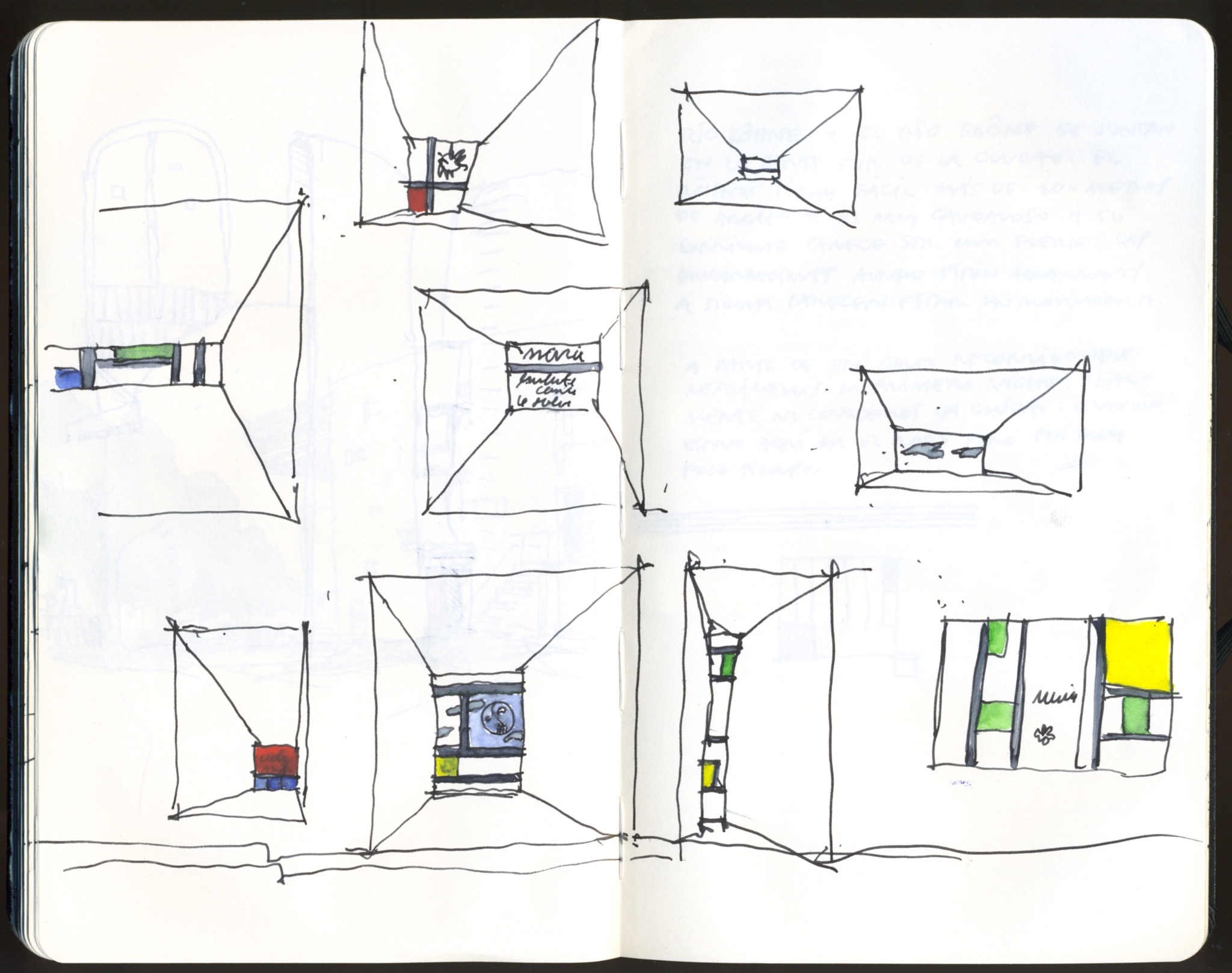 the south wall

Inspired by the Grand Tour tradition, made throughout history by many renowned architects, my wife Claudia and I embarked last summer on an architectural journey along with 22 students.
We sketched intensely in order to absorb as many of the myriad examples we encountered along our trip.
Having been engaged with different freehand drawing media in endorsement of figurative and abstract representation, I have focused on analytical, conceptual drawings as a means to best explain the spatial essence of architecture.
We shared with our students that our trip acknowledged the long-standing tradition of architects that throughout the centuries have transcended the power of literal representation and the nostalgic allure of freehand drawing, to engage instead in the analytical promise inherent to architectural space.

While visiting Italy and France with a group of students I made this sketch — shortly after finishing our visit — to illustrate the spatial experience of Carlo Scarpa’s Castelvecchio Museum in Verona.
These are the kinds of drawings that I enjoy the most, the ones that captures a building’s essence (space and its sequence). I understand they might be hard to comprehend by the untrained eye — in comparison with a traditional two-point perspective — but their purpose is not to portray a picture but to serve as a learning tool.
Design by Pedro Machucha, the Palace of Charles V is undoubtedly one of the best construction of the Renaissance in Spain. Located in La Alhambra it was intended to house the Emperor’s court and residence.
The plan of the palace is square with an inner circular courtyard that imprints its presence within the islamic landscape of la Alhambra as if it were a seal to commemorate the reconquest of the city in 1492.

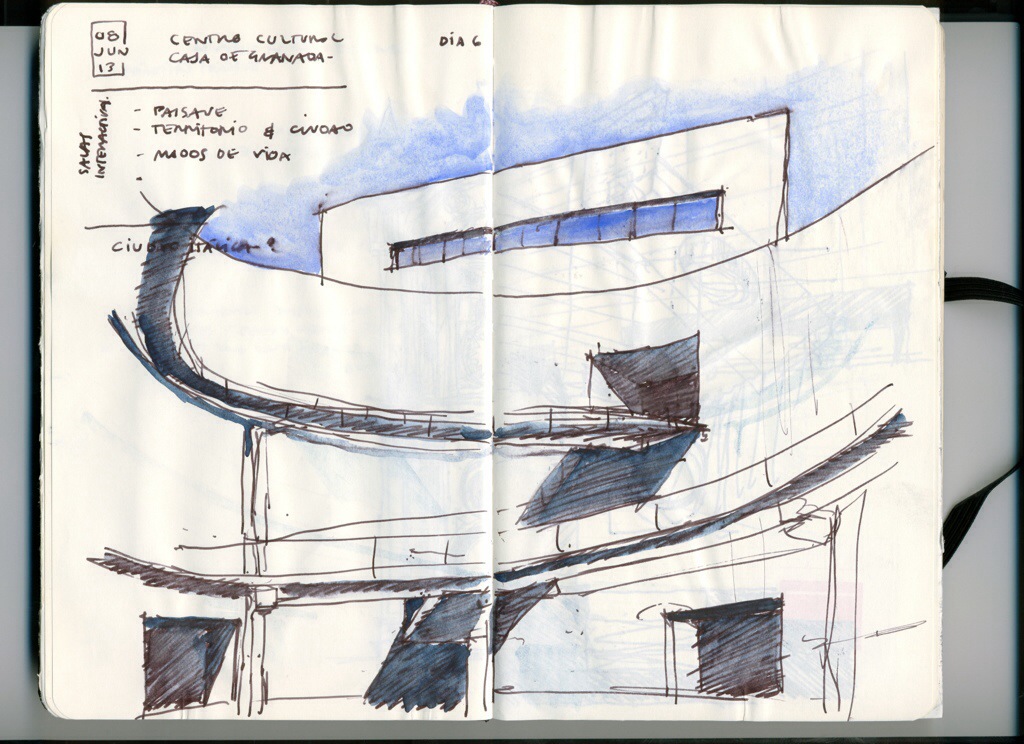
Designed by Alberto Campo Baeza, El Centro Cultural Caja de Granada, also known as El Museo de la Memoria Andaluza is one of the best examples of contemporary architecture in Spain.
The reinforced concrete building (exposed concrete on the outside and white plastered interiors) is comprised of a horizontal base (114 meters long x 54 wide) and an eight stories height tower. The lower volume houses the main exhibition spaces and an auditorium, among other ancillary programs. While the tower (same width as the base but 42 meters height) contains the administrative offices, cafeteria, a public library, reading and meeting rooms and a restaurant at the top that allows panoramic views of La Alhambra, the city of Granada and the nearby landscapes of Sierra Nevada and Sierra Elvira.
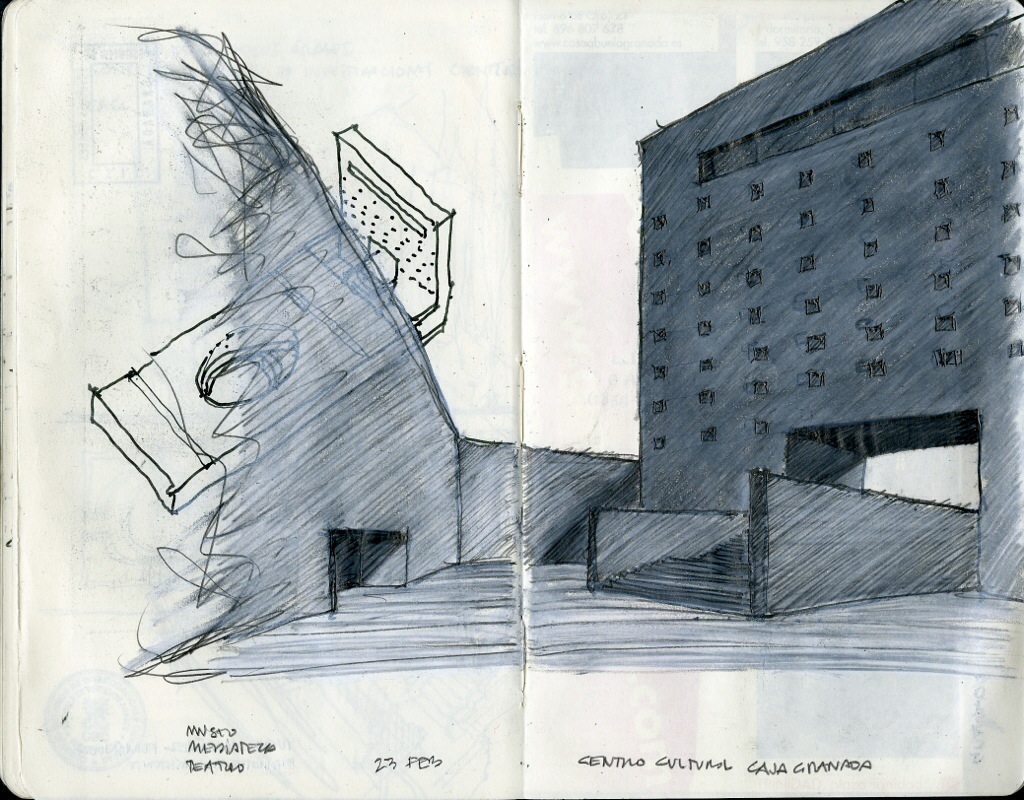
The main façade of the building is monumental, formed by the tower — wider than it is high — rises to the west and is only pierced by the main entrance and the horizontal windows of the restaurant. The rest of the façade stands as a solid mass, as a monumental architectural screen that highlights its prescience within the surrounding context.

The main entrance displays a stainless steel sliding door (mechanically operated) that serves both as banner and harbinger of the monumental scale of the museum’s interior. Once past the main entrance the sequence proceeds by descending an entire floor to a rectangular courtyard that serves as lobby to the tower as well as the main gallery spaces. The patio doubles as additional exhibition area for temporary installations.
Once inside, the sequence of exhibition spaces is organized around an elliptical courtyard, undoubtedly the most important space in the museum. The courtyard emulates in scale, spatial organization and hierarchy the circular courtyard of El Palacio de Carlos V, not far in the Alhambra, and to which Campo Baeza pays homage with the building. The main feature of this open space — in addition to its elegant proportions and monumental scale — is a pair of helicoidal ramps that apart from defying gravity (and many requirements of the ADA law) connect the exhibition spaces, allowing for a dynamic and diverse spatial sequence. Recognized by Campo Baeza himself, the ramps emulate — somewhat literally — Berthold Lubetkin’s penguin pool (1934) at the London Zoo.

This sketch is based on the mural of Le Corbusier’s Swiss Pavilion at the Paris University Campus that I visited for the first time this past summer.
C.5. The image of a woman’s body with a unicorn’s head.
The vessel drifts on
with voices singing on board
as all becomes strange
and is transposed
carried up
and is reflected on
the level of elation

 anonymous_architecture