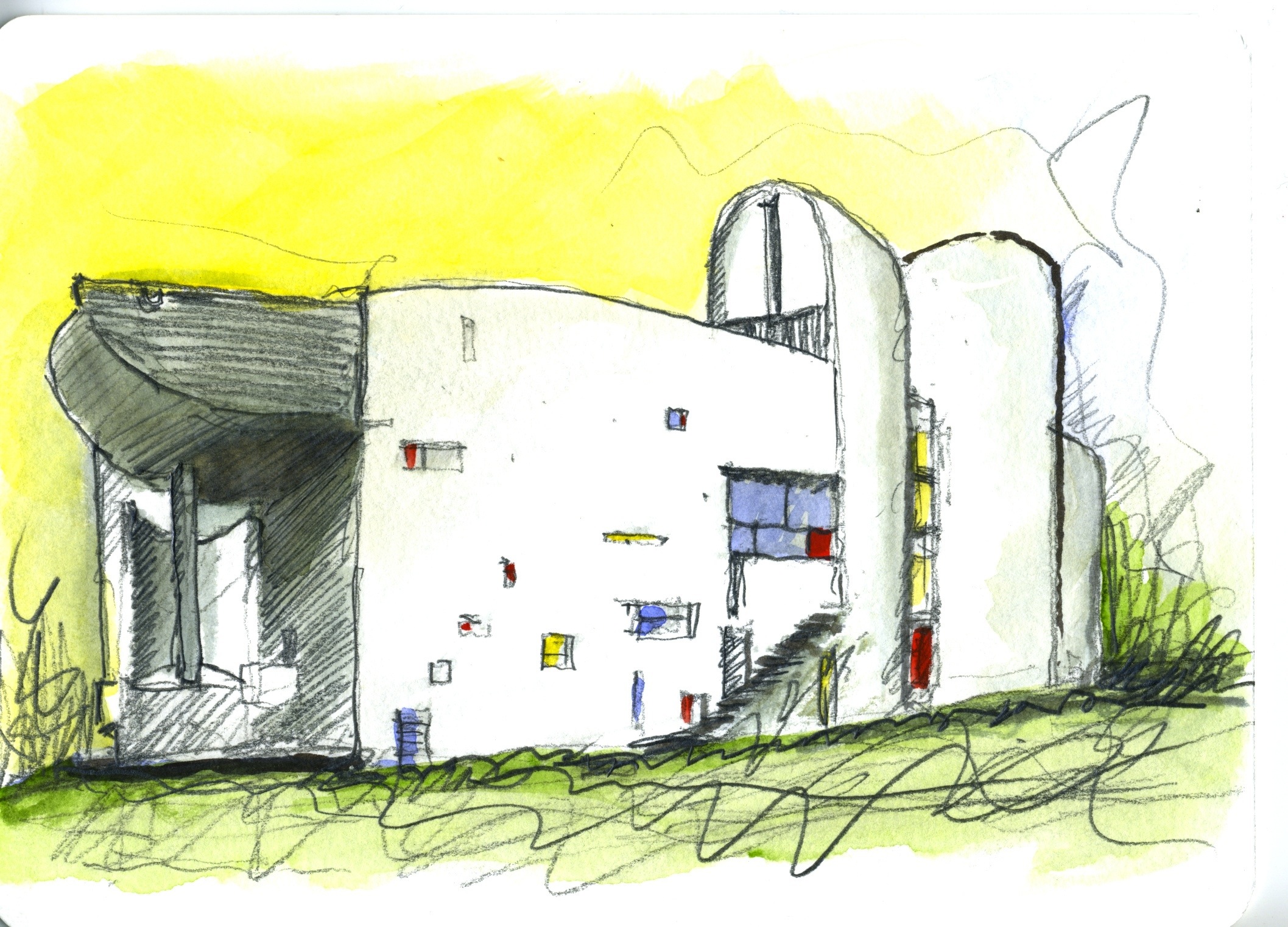
Villa Savoye (1928-1931) Le Corbusier et Pierre Jeanneret

IMG_1759.JPG
The Villa Savoye in Poissy (outside of Paris) was designed by Le Corbusier and his cousin Pierre Jeanneret. Built in reinforced concrete the house best exemplifies Le Corbusier’s five points of modern architecture. These were:

1. pilotis – a grid of reinforced concrete columns that served as main structural support, elevating the house from the ground to allow for the continuity of the landscape underneath.

2. plan libre – given the pilotis there was no need for load-bearing walls to support the structure allowing interior walls to be placed freely and only where the program required them.

3. toit jardin or roof garden – an open-air terrace that reclaimed the landscape displaced by the occupation of the building.

4. fenêtre en longueur – horizontal windows that provided rooms with an equal distribution of natural light and ventilation.

5. façade libre – unconstrained by load-bearing considerations building skins could be arranged freely to serve the requirements of the interior spaces.

IMG_1758.JPG

my take on illustrating Bruno Zevi’s 4th dimension in space

IMG_1744-1.JPG
While visiting Italy and France with a group of students I made this sketch — shortly after finishing our visit — to illustrate the spatial experience of Carlo Scarpa’s Castelvecchio Museum in Verona.

These are the kinds of drawings that I enjoy the most, the ones that captures a building’s essence (space and its sequence). I understand they might be hard to comprehend by the untrained eye — in comparison with a traditional two-point perspective — but their purpose is not to portray a picture but to serve as a learning tool.

Caja de Granada

20140305-231721.jpg

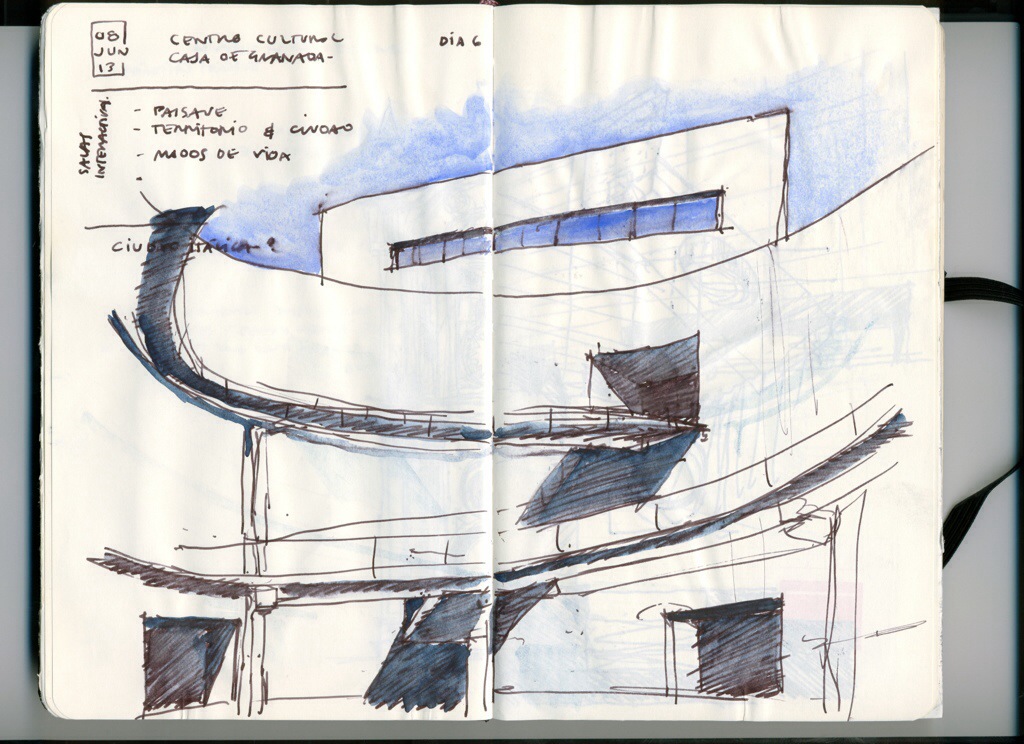
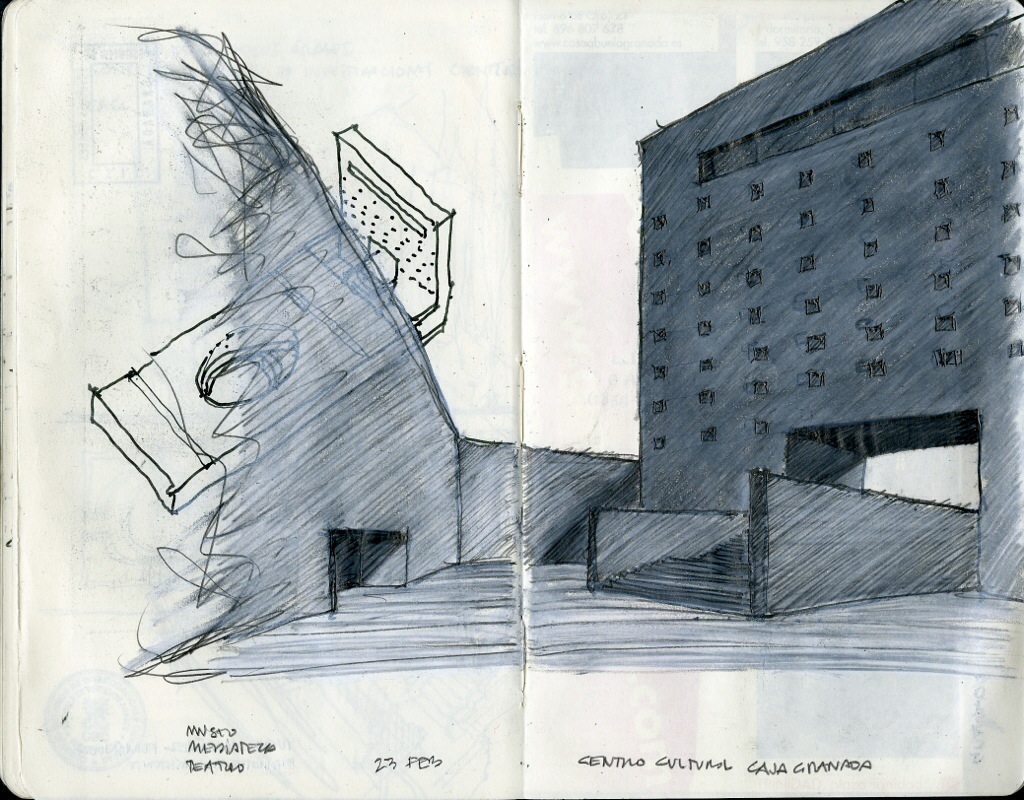
Designed by Alberto Campo Baeza, El Centro Cultural Caja de Granada, also known as El Museo de la Memoria Andaluza is one of the best examples of contemporary architecture in Spain.

The reinforced concrete building (exposed concrete on the outside and white plastered interiors) is comprised of a horizontal base (114 meters long x 54 wide) and an eight stories height tower. The lower volume houses the main exhibition spaces and an auditorium, among other ancillary programs. While the tower (same width as the base but 42 meters height) contains the administrative offices, cafeteria, a public library, reading and meeting rooms and a restaurant at the top that allows panoramic views of La Alhambra, the city of Granada and the nearby landscapes of Sierra Nevada and Sierra Elvira.

20140306-003222.jpg

The main façade of the building is monumental, formed by the tower — wider than it is high — rises to the west and is only pierced by the main entrance and the horizontal windows of the restaurant. The rest of the façade stands as a solid mass, as a monumental architectural screen that highlights its prescience within the surrounding context.

20140306-003442.jpg

The main entrance displays a stainless steel sliding door (mechanically operated) that serves both as banner and harbinger of the monumental scale of the museum’s interior. Once past the main entrance the sequence proceeds by descending an entire floor to a rectangular courtyard that serves as lobby to the tower as well as the main gallery spaces. The patio doubles as additional exhibition area for temporary installations.

Once inside, the sequence of exhibition spaces is organized around an elliptical courtyard, undoubtedly the most important space in the museum. The courtyard emulates in scale, spatial organization and hierarchy the circular courtyard of El Palacio de Carlos V, not far in the Alhambra, and to which Campo Baeza pays homage with the building. The main feature of this open space — in addition to its elegant proportions and monumental scale — is a pair of helicoidal ramps that apart from defying gravity (and many requirements of the ADA law) connect the exhibition spaces, allowing for a dynamic and diverse spatial sequence. Recognized by Campo Baeza himself, the ramps emulate — somewhat literally — Berthold Lubetkin’s penguin pool (1934) at the London Zoo.

20140306-003552.jpg

places I’ve drawn, but have not yet visited series: Le Corbusier’s (& José Oubrerie) L’eglise Saint-Pierre de Firminy

Designed in the mid-1960’s, this church by Le Corbusier was completed by José Oubrerie in 2006 who was a member of the original design staff. Construction started in 1973 but was halted in 1978 due to political conflicts. These drawings were made while looking at slides that my wife took when she visited it.

20130211-003142.jpg

Sert House in Cambridge, Massachusetts

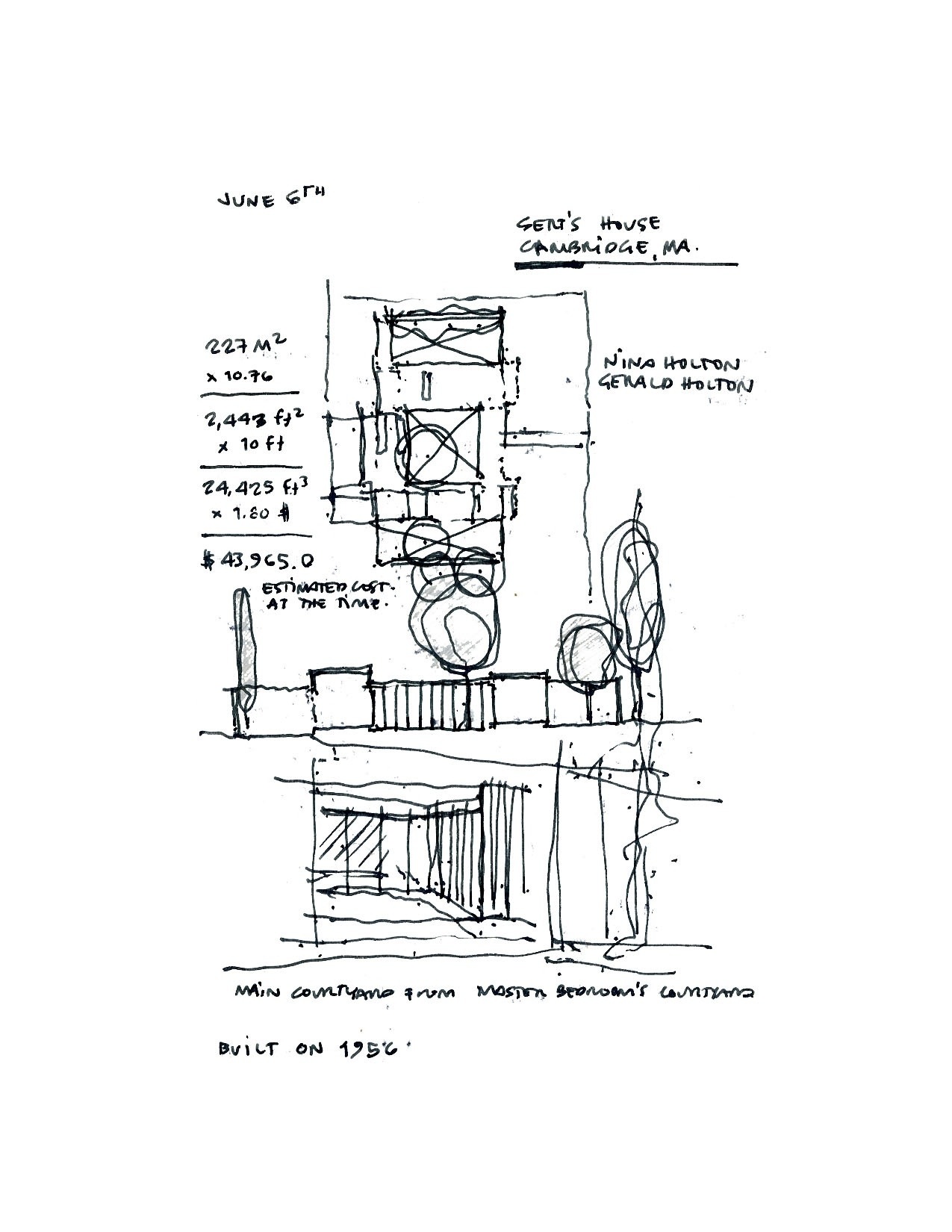
Sert House in Cambridge, Massachusetts (1957-1958) is considered a paradigm of the courtyard-house-type. Designed by the Catalan master Josep Lluís Sert as his private home while he was dean at the GSD the house was conceived as a prototype to be paired with its mirror, “…as part of a future group in a row.”

The house sits on a 900m2 trapezoidal plot of land previously owned by Harvard, at Irving Street, northeast of campus near the Divinity School. Although Sert thought the structure to fit on a 500m2 plot since its basic rectangular form is only 40 x 100 feet – excluding the two protruding volumes of the garage and guest room which expands it to 60 feet wide.

Le Corbusier’s Modulor dimensions and proportioning system were applied throughout the house. Thus, the floor plan proportions derive from the central courtyard, a 7.32m x 7.32m (twice 3.66m), from which the living and dining areas, and the bedrooms volume, as well as the two enclosed courtyards at the north and south are set.

20120812-083650 p.m..jpg

The sketch above is based on one made by Sert himself where he budgeted the house cost and laid out the basic spaces.

20120812-103949 p.m..jpg

Above is a spatial axonometric of the house and transversal section of living and dining room.

More important for me in this page is the small floor plan sketch illustrate a row of trees that were planted by Sert inside his property limits but outside the bedrooms courtyard wood fence, an idea that provided an extended sence of the southern boundaries, years later became a property limit issue with the neighbors.

20120812-104018 p.m..jpg

Below, on top of the perspective view of the main courtyard there’s a partial interior elevation sketch of Sert’s wife dressing room. Here the longitudinal mirror is capped by a pair of square windows in order to cast an equal amount of natural light to the person in front of it. Below the mirror is a cantilevered drawer chest, all of which as been set (mirror and drawers) at seating height.
20120812-104440 p.m..jpg

20120812-104149 p.m..jpg