concrete forms: brise soleils of Henry Klumb

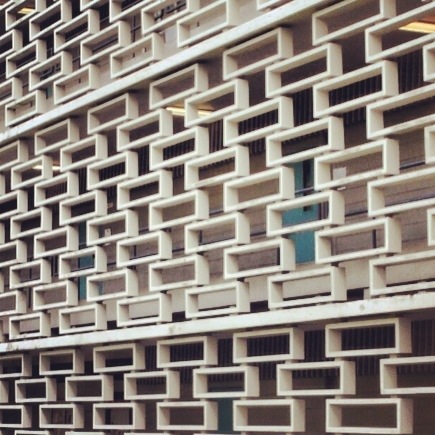
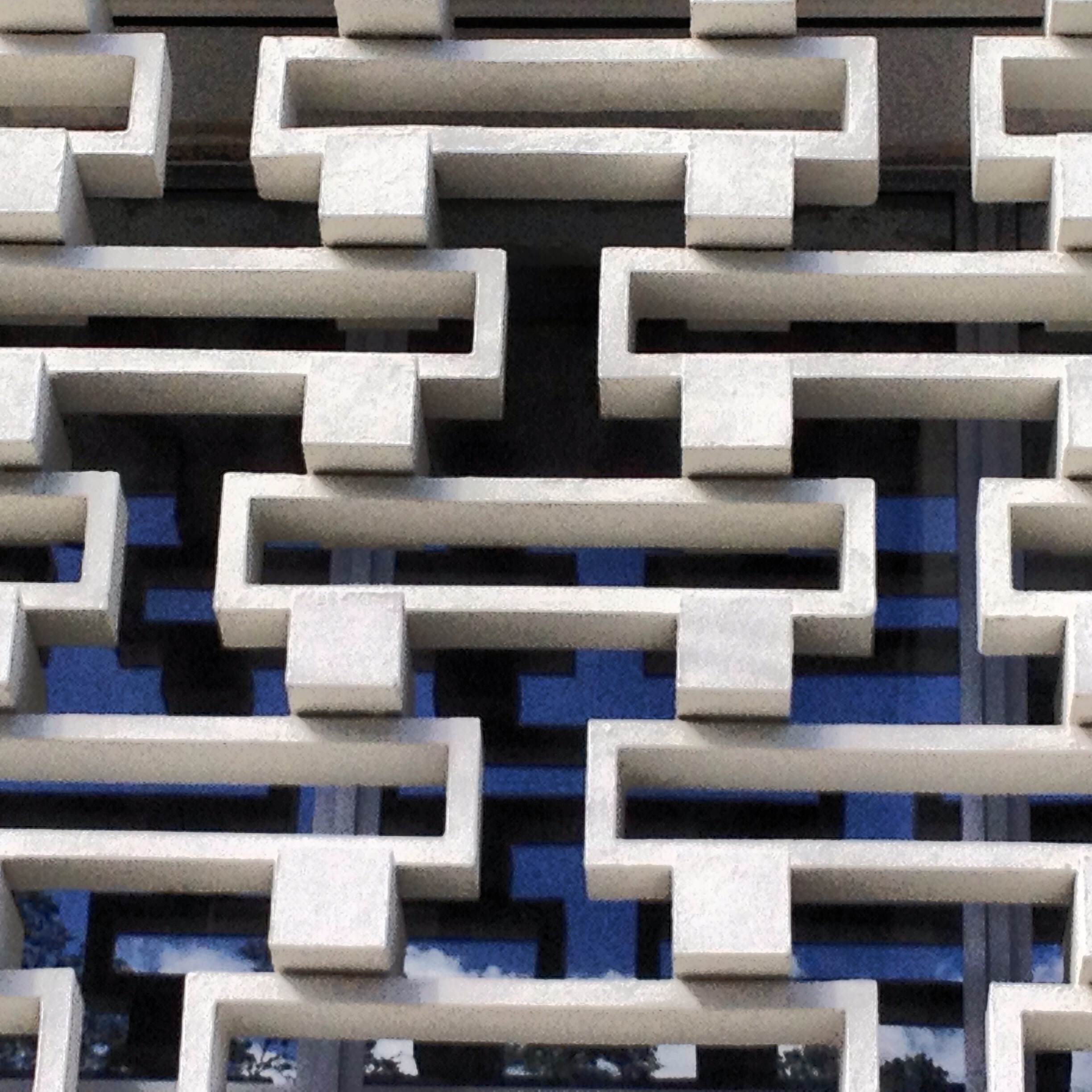
After years of photographing, sketching and even having listened to unsatisfactory explanations, it wasn’t until recently – while visiting the Río Piedras Campus to see the remains of an experimental green roof – that I gained consciousness of the constructive, or rather assembly logic of Henry Klumb’s brise soleil system at the Osuna Building. The following sketches and photos aim to illustrate my understanding of these and other quiebrasoles found at several of the German master’s buildings.
20130128-072237.jpg

20130101-042423 p.m..jpg Based on the concrete brise soleil system at the Juan José Osuna Building, Pedagogy Faculty at the University of Puerto Rico in Río Piedras.
20130128-072519.jpg

20130101-044853 p.m..jpg Based on the concrete façade system at the former IBM building in Santurce, Puerto Rico. The same system was used at the Student Center at the Mayagüez Campus of the University of Puerto Rico.

20130128-072838.jpg

20130101-050351 p.m..jpg Sketch is based on the reinforced concrete brise soleil system at the Law School building at the University of Puerto Rico, Río Piedras Campus. The same system was used at the main library at the Mayagüez Campus.

These are the sketches I made on the visit to the green roof.

20130203-125138 a.m..jpg
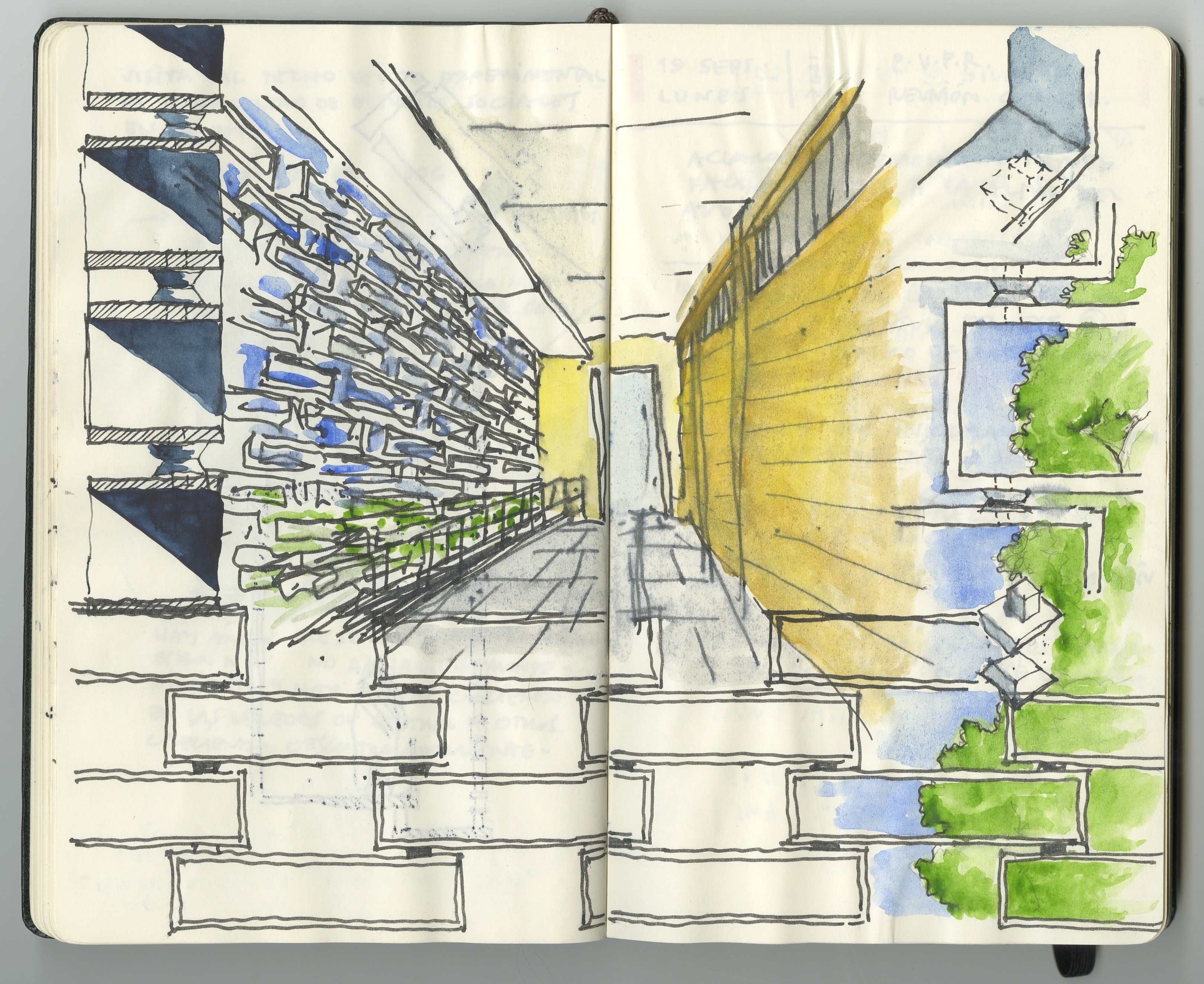
Plan of the green roof at the Faculty of Social Studies and a small site plan indicating its location within the building. The section of the main hallways that lead to the classrooms shows the spatial relationship of the quiebrasoles; the drop and gap between screen and hallway accentuate the separation of the façade freeing it from the main structure. This sketch fails to illustrate the fact that at every level the brise soleil displaces outward at least 6 inches from its vertical axis; a subtle change only visible to those who pay attention. (I wasn’t on that day since I was amazed of my recent discovery).
20130203-125159 a.m..jpg
This pages (a rather awkward composite of sketches) illustrate several aspects of the system; the one point perspective tries to emulate the spatial feeling of the hallways; while at the margins a section and elevations of the screen give way to the ‘blow up’ details of the concrete spacers.

20130203-044016 p.m..jpg
Here’s a section of the classrooms that i made on a separate visit. It not only illustrates the screen’s displacement as you climb floors, but also shows the stepping of the courtyards as one progress from one to the next.
Sert House in Cambridge, Massachusetts

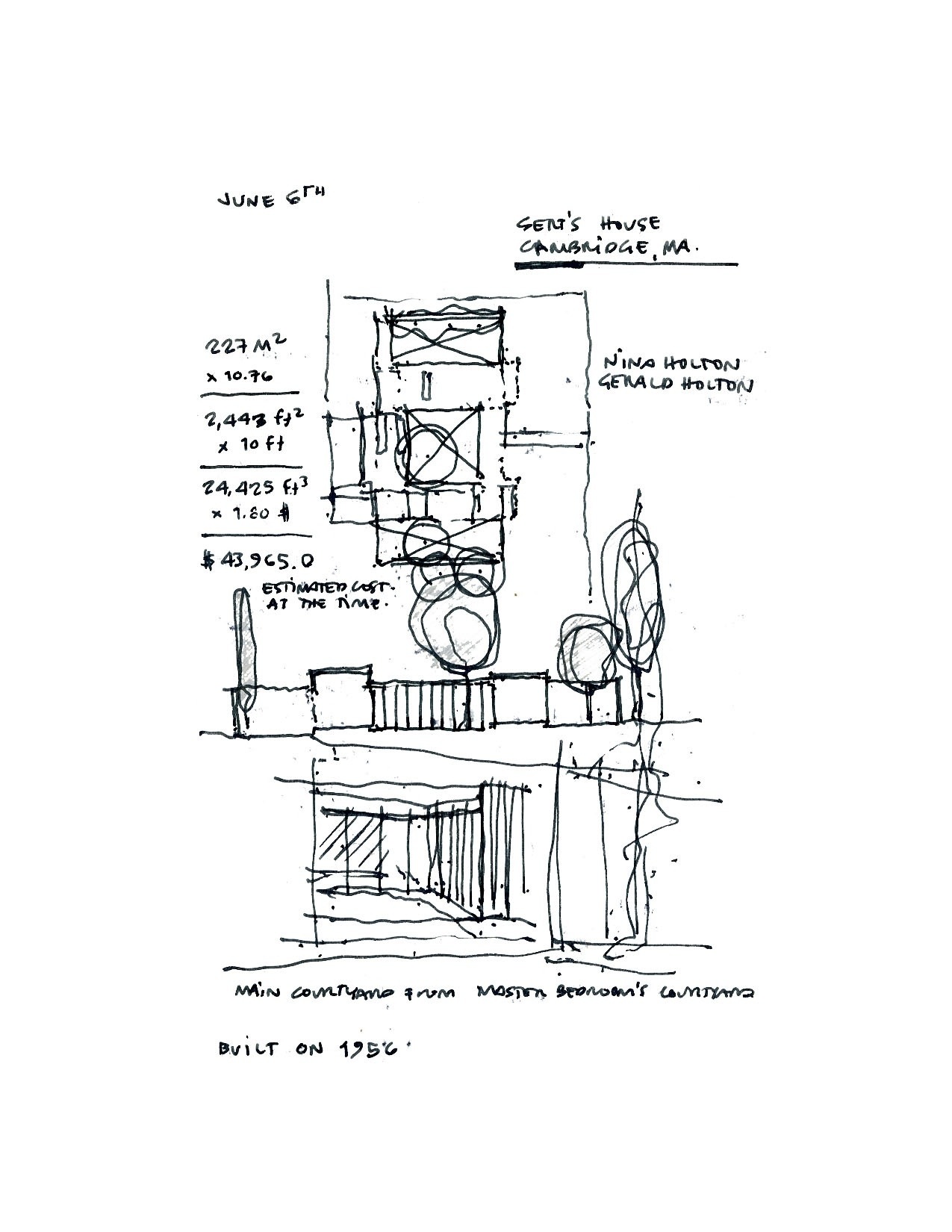
Sert House in Cambridge, Massachusetts (1957-1958) is considered a paradigm of the courtyard-house-type. Designed by the Catalan master Josep Lluís Sert as his private home while he was dean at the GSD the house was conceived as a prototype to be paired with its mirror, “…as part of a future group in a row.”

The house sits on a 900m2 trapezoidal plot of land previously owned by Harvard, at Irving Street, northeast of campus near the Divinity School. Although Sert thought the structure to fit on a 500m2 plot since its basic rectangular form is only 40 x 100 feet – excluding the two protruding volumes of the garage and guest room which expands it to 60 feet wide.

Le Corbusier’s Modulor dimensions and proportioning system were applied throughout the house. Thus, the floor plan proportions derive from the central courtyard, a 7.32m x 7.32m (twice 3.66m), from which the living and dining areas, and the bedrooms volume, as well as the two enclosed courtyards at the north and south are set.

20120812-083650 p.m..jpg

The sketch above is based on one made by Sert himself where he budgeted the house cost and laid out the basic spaces.

20120812-103949 p.m..jpg

Above is a spatial axonometric of the house and transversal section of living and dining room.

More important for me in this page is the small floor plan sketch illustrate a row of trees that were planted by Sert inside his property limits but outside the bedrooms courtyard wood fence, an idea that provided an extended sence of the southern boundaries, years later became a property limit issue with the neighbors.

20120812-104018 p.m..jpg

Below, on top of the perspective view of the main courtyard there’s a partial interior elevation sketch of Sert’s wife dressing room. Here the longitudinal mirror is capped by a pair of square windows in order to cast an equal amount of natural light to the person in front of it. Below the mirror is a cantilevered drawer chest, all of which as been set (mirror and drawers) at seating height.
20120812-104440 p.m..jpg

20120812-104149 p.m..jpg

sketching por la isla: tren urbano

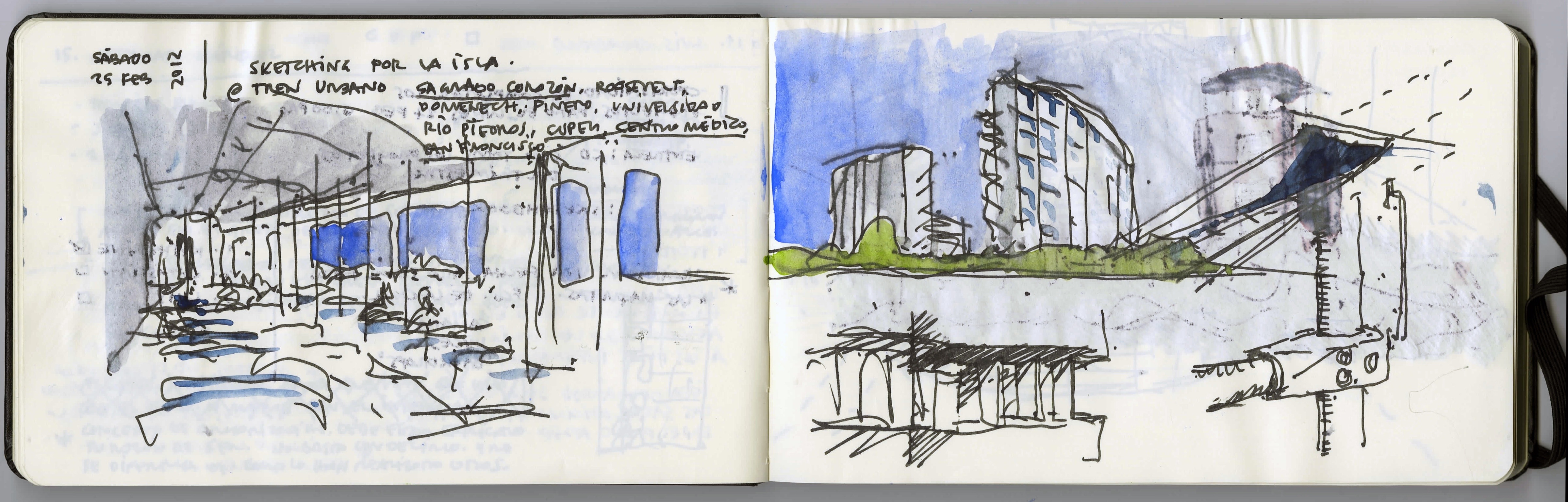
Here are some sketches I made on our last tour sketching por la isla. This time we decided to draw from the “Tren Urbano” (San Juan’s only metro line).

20120317-152938.jpg
inside the train car; the curved buildings of el monte housing complex (where I live); tunnel entrance; san juan’s courthouse façade detail; and grab bar detail.

20120317-153254.jpg
rum testing laboratories’ building at san juan’s botanical gardens; and escalators atrium at centro medicos’ station.

20120317-153652.jpg
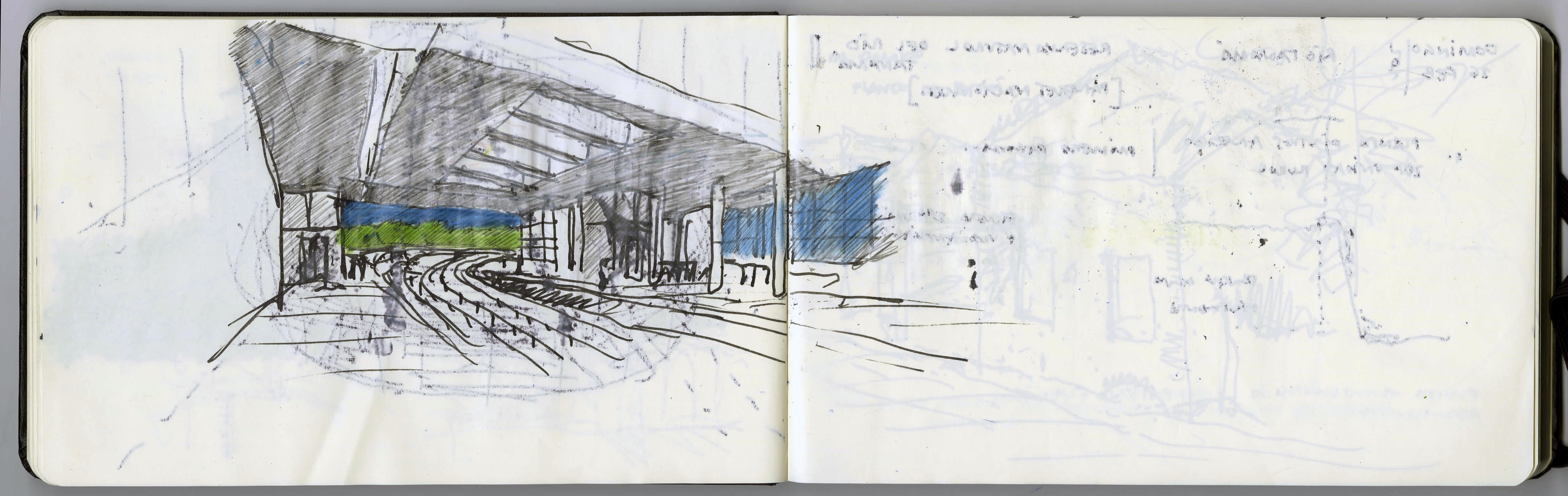
covered platform at cupey station.

a simple resting bed

Here’s a sketch I made “literally” copying Le Corbusier’s own of the design for his father’s tomb, included in a letter to his mother.

In addition to the simple forms, what I like most of the design (and letter) were his notes on the selection of plant material and its careful thoughts on their placement; specially of the species selected for the joints.

Geraniums were picked since they symbolize the good that exists in everybody. While the other species, (yellow or white poppies, alpine pansy, primula or moss) Le Corbusier mentions they were his father’s favorite.

20120303-125655.jpg

on the road: bird’s eye views

20120219-115031.jpg

valle aluvial del río grande de arecibo, puerto rico. (view from PR 10 rest stop)

20120219-114939.jpg

kentuck knob estate, dunbar, pennsylvania. (view from the sculpture garden)

20120219-114850.jpg sideling hill, freeway 40 (while at a rest stop between washington dc to pennsylvania)