Mies van der Rohe’s Farnsworth House

The National Trust for Historic Preservation is considering relocating Mies van der Rohe’s Farnsworth House out of the Fox River floodplain. The idea is to move the structure from its original location parallel to the waterway to a nearby site, still along the river, but on a higher elevation. Throughout the years the house has been affected significantly by floodwaters at least three times. The last major damage occur in 1996 and the restoration costs elevated to almost half a million dollars. At that time, the flood broke windows, damaged the travertine marble floors and ruined the teak cabinetry.

The solution of moving the house is not the only one the Trust has juggled in order to protect the house from further damages. Two additional solutions not requiring to relocate the house have been contemplated so far. One — less viable, although favored by Dirk Lohan, a Chicago based architect and Mies’ grandson — requires the installation of hydraulic jacks underneath the foundations to lift the house during floods. A second one, provides to permanently raise the house on top of a 9-foot mound.

Each one of the alternatives entail major impact on the National Historic Landmark and needless to say, has raised many eyebrows not only on preservationists, but also throughout the architectural community. One of the leading voices is Mr. Lohan who was in charge of the 1996 restoration. He argues that moving the structure “…is not in keeping with the design concept of the house, which was a house in a flood plain, close to the river…The river was part of its immediate environment. To move it to higher ground where it never floods would be ridiculous. You would ask: ‘Why is it on stilts?’ It makes no sense to me.” 

Having visited the house for the first time last month I really don’t see the problem with moving it. Arguably, given the nature of the house, an elevated object that relates to the river just by being in proximity to it and not much else, I see no problem in relocating it to a higher site to relieve the enormous preservation pressure and most importantly avoiding escalating restoration costs. 

One knows that the success of the strategy depends on the execution and the careful conditioning of the new site to retain the overall experience. Nevertheless, I strongly believe that regardless of its location the house will continue to inspire future generations if the right action is pursuit, sooner rather than later, in order to move it out of harm’s way.  

two cities, a park, a garden and two urban panoramas

   Brooklyn Bridge Park by Michael Van Valkenburgh and Associates.

  View towards Manhattan from the northwest corner of MVVA’s park. 

  Lurie Garden designed by GGN; Kathryn Gustafson, Jennifer Guthrie & Shannon Nichol at Chicago’s Millenium Park 

 Cloud Gate by Anish Kapoor; Millenium Park, where Chicago’s skyline is reflected and interestingly distorted as if captured by a wide-angle lens. 

caixa forum madrid _ herzog & de meuron

Designed by the Swiss duo Jacques Herzog and Pierre de Meuron CaixaForum Madrid is a contemporary art museum and cultural center near Paseo del Prado.

IMG_0536

The architects manage to make an existing brick structure defy gravity in order to provide an open ground floor, a strategy already tested – albeit timidly – at the Tate Modern in London. However, the feat is more interesting for its structural audacity than for the space gained. The free plan allows the building to hover while a stainless steel staircase invite visitors to enter. Nevertheless, due to the sloping terrain the noble intention of providing access from every street is not possible. Thus, the southwest area and the entire west façade are inaccessible since they remain sunken in relation to the sidewalks. One third of the square lies underutilized most of the time despite attempts by the designers to program it with benches and a leaking fountain.

IMG_0406

The opening at the corner of Almadén Street allowed the museum to become visible from Paseo del Prado. The square is complemented by a vertical garden conceived by the French botanist Patrick Blanc.

IMG_0533

The main staircase, along with the entrance stair and the auditorium, is one of the hierarchical spaces of the Caixa Forum. Built in reinforced concrete, the staircase (illustrated above) literally pierce and spatially connects all museum levels. But, at each level the sculpted space is funneled rather awkwardly at the entrances of exhibition space.

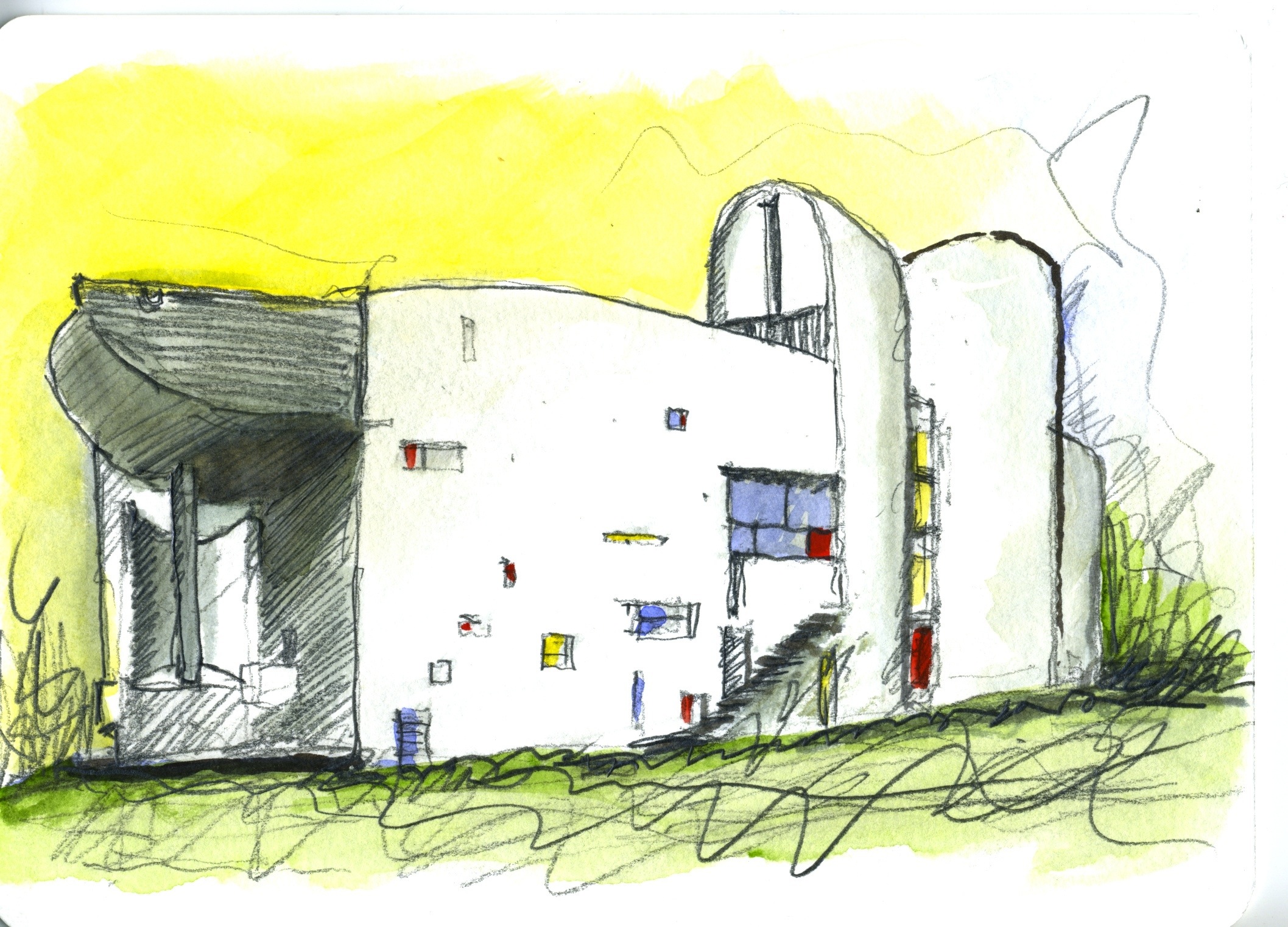
Le Corbusier’s (& José Oubrerie) L’eglise Saint-Pierre de Firminy

This is a follow up on our trip to Italy and France last summer where we got the chance to visit the cultural complex at Firminy-Vert. Here are a few quick sketches made on site; a few trying to capture the feeling of the interior space.

IMG_0520

IMG_0521

IMG_0525

IMG_0530

Casa Klumb

The Klumb house, previously known as el Rancho Cody, was acquired by Henry Klumb in 1947. The house belonged to José Ramón Latimer and his wife Esther C. Cody who rented out rooms. In 1949 Klumb remodel the structure which was a traditional pitched-roof wood structure raised from the terrain with a surrounding balcony that opened directly towards the outside.

The intervention instead of consisting of additions to the original layout was more about subtraction as if adhering to Mies’ “less is more” predicament. Klumb eliminated — almost entirely — the enclosing walls to allow continuity between the public spaces of the house and the veranda. Thus, the living room (in the front) and the dinning room (at the back) — maintaining the original layout — were left completely open. The bedrooms remained partially enclosed and large operable pivoting windows allowed for privacy while allowing cross ventilation and when opened visual and physical connection with the balcony.

Klumb, his wife Else and their two children Peter and Richard lived in the house until 1984 when Klumb and Else died as a result of a car accident.

After their death, the house was acquired by the University of Puerto Rico in 1986, but was left abandoned to its current state of deterioration. In 1997 it was included as a Regional Monument in the National Register of Historic Places and in 2012 it was elevated to the status of National Monument by the same entity. In 2014 the house was included in the World Monuments Watch and in March Comité Casa Klumb was created to aid at the restoration of the structure.

Here are a few drawings I made during a visit to the Casa Klumb organized by the committee as part of a series of activities aimed at raising awareness of the house condition and its future restoration.

IMG_1791.JPG The living room

IMG_1792.JPG The dining room

IMG_1790.JPG The dining room table

IMG_1789.JPG floor plan and axon

Villa Savoye (1928-1931) Le Corbusier et Pierre Jeanneret

IMG_1759.JPG
The Villa Savoye in Poissy (outside of Paris) was designed by Le Corbusier and his cousin Pierre Jeanneret. Built in reinforced concrete the house best exemplifies Le Corbusier’s five points of modern architecture. These were:

1. pilotis – a grid of reinforced concrete columns that served as main structural support, elevating the house from the ground to allow for the continuity of the landscape underneath.

2. plan libre – given the pilotis there was no need for load-bearing walls to support the structure allowing interior walls to be placed freely and only where the program required them.

3. toit jardin or roof garden – an open-air terrace that reclaimed the landscape displaced by the occupation of the building.

4. fenêtre en longueur – horizontal windows that provided rooms with an equal distribution of natural light and ventilation.

5. façade libre – unconstrained by load-bearing considerations building skins could be arranged freely to serve the requirements of the interior spaces.

IMG_1758.JPG

Study Abroad in Northern Italy and France

IMG_1743.JPG

Inspired by the Grand Tour tradition, made throughout history by many renowned architects, my wife Claudia and I embarked last summer on an architectural journey along with 22 students.

We sketched intensely in order to absorb as many of the myriad examples we encountered along our trip.

Having been engaged with different freehand drawing media in endorsement of figurative and abstract representation, I have focused on analytical, conceptual drawings as a means to best explain the spatial essence of architecture.

We shared with our students that our trip acknowledged the long-standing tradition of architects that throughout the centuries have transcended the power of literal representation and the nostalgic allure of freehand drawing, to engage instead in the analytical promise inherent to architectural space.

my take on illustrating Bruno Zevi’s 4th dimension in space

IMG_1744-1.JPG
While visiting Italy and France with a group of students I made this sketch — shortly after finishing our visit — to illustrate the spatial experience of Carlo Scarpa’s Castelvecchio Museum in Verona.

These are the kinds of drawings that I enjoy the most, the ones that captures a building’s essence (space and its sequence). I understand they might be hard to comprehend by the untrained eye — in comparison with a traditional two-point perspective — but their purpose is not to portray a picture but to serve as a learning tool.